Thursday, January 20, 2011

From deflation to inflation?

The world has recently seen rising prices which are not only a concern for economic stability but also causing deadly riots in North Africa, where Tunisia's Ben Ali was forced into exile after 23 years in dictatorship.

Inflation has been creeping into advanced nations, too. The UK's consumer price index in December increased 3.7% from the previous year, the highest since April 2010. The largest contributor to December's rise was transport which claimed nearly 30% of total increase. Food was the second largest contributor, and restaurants the third.

Likewise, Germany's Harmonised Index of Consumer Prices (HICP) rose 1.9% in December, the biggest since October 2008. About 40% of rise came from energy, which was the largest contributor to nearly two-year high. Traffic and food followed.

Meanwhile, the US is also feeling the rise of inflation, albeit very slowly, even though deflation was perceived as the biggest risk for a little while back. A 1.5% growth of CPI in December is lower than the UK and Germany, but it's the highest in 8 months, nonetheless. Transportation was the largest driver of the increase, beating medical care and food and beverages.

The common factor behind the latest inflation in those three countries is the rise of energy and food price. Transportation is the prime sector that passes through soaring energy costs on fares. Restaurants are also vulnerable to the swing of food prices, and have little choice but to raise retail prices in face of escalating food prices.


The fear of inflation is gradually appearing on a radar screen of European authorities' mind. In the recent interview, ECB President Jean-Claude Trichet brought inflation fighting back to the agenda.
European Central Bank President Jean-Claude Trichet said policy makers are monitoring price developments "very closely" after euro-area inflation breached the ECB's limit in December, Germany's Bild newspaper reported.

"We are always concerned if inflation rises and are following developments very closely," Trichet told the newspaper in an interview. "But the figures for December can be accounted for, above all, by rising energy prices."
Reuters poll indicates that some analysts are anticipating the Bank of England's rate hike in as early as the third quarter of this year, though a majority forecasts a rise in the fourth quarter.

This is all happening when economic activity around the world is still and will be fragile for a while, at least this year. It should be dubious that inflation persists with considerable resources still in slack mode, but the world might have to recall how to tackle and tame stagflation in the 1970's.

Labels: , ,

Wednesday, December 01, 2010

Doubts on Germany's consumption-led growth

Germany is booming. The IMF predicts that Europe's largest economy will grow 3.3% this year, the highest among major advanced economies. The latest Ifo Business Climate Index, a closely watched indicator of Germany's economy, marked 109.3, the highest since unification. Some might think of bouncing consumption as the principal driver of the country's recovery, which wouldn't be enough to save the world but at least could help ailing allies in Europe amid intense pressure, mainly from the US, to expand domestic demand to dissolve global imbalances.

Is a country which has been renowned for its gigantic exports transforming itself from an export-dependent to a consumption-led economy? The details of Germany's third quarter GDP would illustrate a somber picture, as opposed to some claims, of a country which still has to rely on external demand to bolster its development while on the way to a service economy.

Regarding to the Ifo Business Climate Index, Germany's Economy Minister Rainer Bruederle is boasting that "Germany's economic recovery is self-sustaining," and "Germany is on a fast track towards the goal of full employment."

Unfortunately, to sustain the economy, Germany is still badly in need of the world demand. Exports' share rose above 51% in GDP, the highest in two years, whereas domestic consumption's share fell to the two-year low. External balance, exports minus imports, has gradually claimed an increasing share among GDP after plummeting in 2009. Household consumption contributed to more than one third of GDP growth in the third quarter, but it's quite uncertain about the durability of domestic demand without exports.


The other important important aspect of Germany's economy is that the increase in employment is almost coming from a service industry, not manufacturing. In fact, 40% of the increase in the third quarter employment derives from finance, and 30% from other services, while manufacturing has only 16%.

The rise of service industry has changed a compensation structure. Finance and other services compensation have already reached above the pre-Lehman crisis level, whereas manufacturing is still 3% lower.

Moreover, in terms of gross value added, other services has grown 4%, and finance 1% since the Lehman crisis, but manufacturing has lost 9%.


What do these numbers tell us about Germany's economy? Severe price competition coupled with rising costs could cap revenue, hence compensation and employment in the coming months. On the other hand, the economy is mutating into a service-base society for more profits and opportunities, but would stagnate given a lackluster domestic demand. Germany would have to make sure that its domestic recovery is enduring enough to sustain the economy, hence able to absorb exports from other countries.

Labels:

Saturday, November 20, 2010

Who bears cost?

The US has every reason to fear disinflation which could spiral into deflation. As the last post shows, core CPI, CPI excluding volatile goods like food and energy, has increased only 0.61% in October over the year, the smallest on record.

Why is low inflation a problem? It appears to be a bonanza for consumers, because they can afford to buy low-priced goods and services, be it from Chinese or domestic markets. But things aren't so easy as is life itself.

One of the reasons why the inflation rate is so low in the US is that given a considerable gap between supply and demand, US companies have failed to pass through costs coming from soaring commodity prices onto consumers. In other words, companies have very weak pricing power over their products.

Businesses have to struggle in a quagmire of low margins, and as a consequence are unwilling to turn to labor markets, which could cap personal income, and hence reduce the purchase of even such low-priced goods. If so, cash-strapped companies would be compelled to cut more costs, and on and on... In the meantime, inflation could die down even into a negative territory, that is, deflation. This "vicious cycle" would continue until a wide gap between supply and demand goes away so that corporations regain control over prices, which would end up as a resumption of, more or less, price increase.

Low inflation environment brings a classical case of prisoner's dilemma for companies. Every company wants to reflect higher costs on selling price, but is afraid to lose when does it because there is no assurance that others follow suit. They might leave prices at the same low level to gain market share and push competitors out of business. Hence, there is a huge incentive to cut cartel agreements on price adjustment.

The comparison with other countries, especially the UK, clarifies how US corporations have lost pricing power in the midst of growing costs.


First, let's look at the CPI, the index of prices that consumers pay. October's CPI in three countries, the US, the UK, and Germany, increased 1.2%, 3.1%, and 1.3%, respectively, over the year. Among them, UK's inflation rate is quite notable compared with the other two.

On the other hand, the PPI, the index of prices that producers sell, rose 4.3%, 4.0%, and 4.3%, respectively, in October from the previous year. Output price increased almost the same across all three countries.

What do these numbers tell us? UK consumer prices grew higher relative to the others while factory prices rose similarly in all three. In other words, UK companies have succeeded in a cost pass-through while the other two have to internalize cost pressure.

Britons may look like paying more than Americans, but the reason is not that British prices are too high, but its domestic demand is just brisker than the counterparts. A storm of cost cut would overwhelm American and German corporations.

Labels: , ,

Monday, November 15, 2010

Europe's economy slows

It looks like a strong recovery from the rock bottom after the Lehman crisis has ended at last across the globe. First, let's look at Europe's economy as a whole, which grew 0.4% in the third quarter, slowing from the previous quarter's 1.0%.
Europe's economic growth weakened in the third quarter from the fastest pace in four years as governments' austerity measures to cut record budget deficits dented the recovery.
Gross domestic product in the 16-nation euro area rose 0.4 percent from the second quarter, when it increased 1 percent, the European Union's statistics office in Luxembourg said today. Economists expected a gain of 0.5 percent, the median of 35 estimates in a Bloomberg News survey showed. Industrial output fell 0.9 percent in September from the previous month, the largest drop in 18 months, separate data showed.
Europe's economic expansion is cooling as leaders grapple with how to handle the sovereign-debt crisis, which has pushed Irish bond yields to records and weakened the euro on concern the EU may need to step in. Ireland and Greece have failed to restore economic growth as they contend with bloated deficits and soaring borrowing costs, while Germany's expansion slowed from the record pace in the second quarter.
"The squeeze from fiscal consolidation programs on the periphery will build," said Ken Wattret, chief euro-zone economist at BNP Paribas in London. "That contrast between Germany driven by strong demand for its exports and the periphery really struggling is going to become more rather than less pronounced."
Six-Week Low
The euro sank to a six-week low against the dollar on concerns about the sovereign-debt crisis and slowing economic growth. The European currency, which is set for its biggest weekly loss since August, traded at $1.3689 at 12:01 p.m. in London, up 0.2 percent on the day.
German GDP increased 0.7 percent from the previous three months, when it surged a record 2.3 percent, while third-quarter growth in France slowed to 0.4 percent from 0.7 percent in the prior period, the statistics office said. Italy's expansion slowed to 0.2 percent from 0.5 percent and the Netherlands' economy contracted 0.1 percent following growth of 0.9 percent in the prior quarter.
Greece's economy contracted 1.1 percent in the latest three months and Spain stagnated, today's data showed. Portugal's growth accelerated to 0.4 percent in the quarter from 0.2 percent in the previous three months. The statistics office didn't publish data for Ireland.
New Mechanism
Group of 20 leaders meeting in Seoul discussed Ireland's debt crisis, and European finance ministers there sought to reassure bondholders about a new system to handle future crises in euro-area nations. Bonds of Ireland and Portugal have tumbled since EU leaders on Oct. 29 backed a German demand to set up a permanent debt-rescue mechanism by 2013. Germany wants bondholders to foot part of the cost of any future crisis.
"Any new mechanism would only come into effect after mid- 2013 with no impact whatsoever on the current arrangements," the ministers of Germany, France, Italy, Spain and the U.K. said in a statement in Seoul. The G-20 leaders endorsed gradual changes in exchange rates and agreed to develop early-warning indicators to monitor policies that exacerbate trade imbalances.
From a year earlier, euro-area GDP rose 1.9 percent, the same rate as the second quarter, today's report showed. The statistics office will publish a detailed breakdown of the data on Dec. 2. The report also showed the U.S. economy grew 0.5 percent in the third quarter, based on an EU measure.
'Big Probability'
Europe's recovery may be restrained as governments step up budget cuts to reduce deficits and restore investor confidence. The yield premium on Irish and Portuguese 10-year debt over the equivalent German security rose to records this week on investor concern that they won't be able to fund themselves.
Goldman Sachs Group Inc. Chief European Economist Erik Nielsen said on Nov. 8 there's a "big probability" that Ireland and Portugal will turn to the EU and the International Monetary Fund for help unless "markets suddenly calm down."
The European Central Bank kept its benchmark interest rate at a record low of 1 percent on Nov. 4 and President Jean-Claude Trichet signaled that the bank will stick to its exit strategy even as a faltering economy makes it harder for governments to plug shortfalls. The ECB has purchased government bonds and provided banks with emergency liquidity to bolster lending.
In the U.S., the Federal Reserve last week decided to buy more assets to prop up the world's largest economy. The Bank of Japan said on Nov. 5 that the recovery "seems to be pausing" after pledging to keep borrowing costs near zero.
Mounting Debts
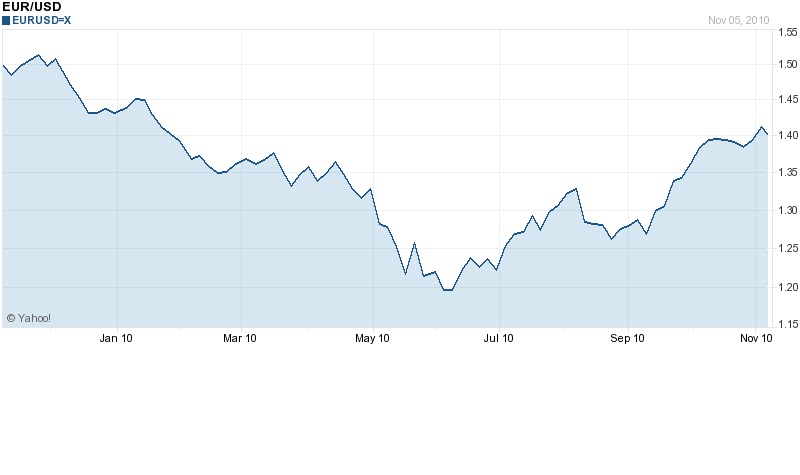
Concern about governments' ability to push down mounting debts sparked a 15 percent drop by the euro against the dollar in the first half of the year, helping to boost exports. HeidelbergCement AG, the world's No. 3 maker of cement, said on Nov. 4 that third-quarter profit more than doubled. Daimler AG, the world's second-biggest maker of luxury vehicles, last month increased its full-year earnings forecast.
European companies remain dependent on faster-growing economies in emerging markets to bolster earnings as euro-area unemployment at a 12-year high restrains consumer spending. Continental AG, Europe's second-largest car-parts maker, on Nov. 3 raised its 2010 forecasts, citing demand in Asia and South America. L'Oreal SA, the world's largest cosmetics maker, said in October that nine-month sales in Western Europe lagged other markets.
"It's clear that the budget consolidation and weaker global demand are weighing on an expansion," said Carsten Brzeski, a senior economist at ING in Brussels. "But we're still far from a double-dip recession."
Budget Consolidation
Industrial production in the euro region rose 5.2 percent in September from a year earlier after jumping 8.4 percent the previous month, today's report showed. Production of durable consumer goods declined 3 percent from August, while output of intermediate goods fell 1.3 percent.
Nations such as China and Brazil are powering the global expansion, widening a gap with advanced economies that are struggling to revive domestic demand. The Washington-based IMF said on Oct. 6 that developing nations will grow 6.4 percent next year, almost three times the pace projected for industrialized economies including Europe and the U.S.
"The recovery which is there, obviously, is uneven because there's a significant difference between emerging economies and advanced economies," Trichet said on Nov. 8 after a meeting with global counterparts. "There is a degree of uncertainty."
What's notable here is that, according to the report, "governments' austerity measures to cut record budget deficits dented the recovery." Now, what about Germany? The biggest economy in Europe also grew less than the previous quarter.
German economic growth slowed in the third quarter, after record expansion in the second, as the cooling global recovery crimped export demand.

Gross domestic product, adjusted for seasonal effects, rose 0.7 percent from the second quarter, when it surged an upwardly revised 2.3 percent, the Federal Statistics Office in Wiesbaden said today. Economists predicted the economy would expand 0.8 percent, the median of 37 estimates in a Bloomberg News survey shows. Separately, France said GDP rose 0.4 percent in the third quarter after a 0.7 percent gain in the second.

Germany is driving growth in the 16-nation euro area as debt-strapped countries such as Ireland, Portugal and Greece grapple with a loss of investor confidence in their ability to finance themselves. Germany's economy, Europe's largest, will expand 3.7 percent this year, the government's council of economic advisors forecast this week. That would be the fastest growth since 1991.

"This is an incredible number for Germany," Andreas Scheuerle, an economist at Dekabank in Frankfurt, said of the third-quarter report. "Consumption has picked up, investment is strong. What else do you want? We're expanding at high speed and twice our potential."

Weber's Prediction

Growth also exceeded the expectations of Bundesbank President Axel Weber, who said on Oct. 25 the economy would expand about 0.5 percent in the third quarter. The euro was little changed after today's data, trading at $1.3637 at 9:48 a.m. in Frankfurt.

The statistics office said trade and investment as well as household and government spending all contributed to growth in the third quarter. From a year earlier, GDP increased 3.9 percent. Second-quarter growth was revised from 2.2 percent.

"Some might label today's growth rate as a slowdown, in our view 'normalization' suits better," said Carsten Brzeski, an economist at ING in Brussels. "The impressive second-quarter performance was a one-off and will not be repeated any time soon."

Euro-area growth probably slowed to 0.5 percent in the third quarter from 1 percent in the second, according to another Bloomberg survey of economists. Eurostat, the European Union's statistics arm in Luxembourg, will publish that data at 11 a.m. today.

The Austrian economy expanded 0.9 percent in the third quarter after growth of 1.2 percent in the second. Holland's contracted 0.1 percent following growth of 0.9 percent.

Widening Gaps

The region's sovereign debt crisis is widening the gaps between its members. Greece's economy probably shrank 4.3 percent in the third quarter, its seventh quarterly contraction, and Portugal's GDP may drop 0.1 percent, economist surveys show.

That may force the European Central Bank to leave stimulus measures and record-low interest rates in place longer than necessary for Germany, where falling unemployment is boosting prospects for consumer spending.

"If you look at growth, the labor market and government finances in Germany, these all suggest it would normally soon need a rate hike," said Aline Schuiling, an economist at ABN Amro Bank NV in Amsterdam. "But of course the ECB can't separate it from the rest of the euro zone. The government might need to do more fiscal tightening if they want to prevent the economy from overheating."

Germany's Siemens AG, Europe's largest engineering company, yesterday announced a bigger-than-estimated increase to its dividend for 2010.

'Full Momentum'

"We're coming out of the economic downturn with full momentum," Siemens Chief Executive Officer Peter Loescher said. "Our growth is gaining speed. We expect to take this positive momentum into the next fiscal year."

Bayerische Motoren Werke AG, the world's top maker of luxury vehicles, raised its 2010 forecast after reporting an 11- fold jump in third-quarter profit. Bilfinger Berger, Germany's second-largest construction company, has lifted its outlook for 2010, and luxury clothier Hugo Boss AG reported a 79 percent jump in third-quarter profit.

The cooling global economy and a stronger euro may damp exports. The International Monetary Fund forecasts global growth will slow to 4.2 percent next year from 4.8 percent this year. In China, economic expansion eased in the three months through September, and the U.S. Federal Reserve is buying an additional $600 billion of Treasuries to bolster its ailing economy.

That's helped the euro advance 14 percent against the dollar since early June, threatening export price competitiveness outside the euro region. Within the currency zone, Germany's biggest export market, governments are cutting spending and raising taxes to push down budget deficits.

Still, Germany has become "less dependent on exports and, encouragingly, more reliant on domestic demand," said Alexander Koch, an economist at Unicredit in Munich. "Investment activity will pick up further. Above all, consumer expenditure has risen markedly."
This Bloomberg report sees the reason for slower growth as the abating global recovery which reduced the country's exports. But some has a different opinion. An economist at ING is quoted to say, "Some might label today's growth rate as a slowdown, in our view 'normalization' suits better." Also, another economist brags that Germany is now "less dependent on exports and, encouragingly, more reliant on domestic demand."


Is that really so?

Second thought would be required to assess the current condition of German economy. As my previous post showed, exports' share is close to 50% in Germany's GDP, and its contribution to GDP growth exceeds GDP growth itself much more, meaning that Germany is heavily dependent on exports for development. Given that the country is now on the way to cutting budget deficit and the euro is on a high plateau, "normalization" would sound like a petty consolation.

Labels: ,

Wednesday, November 10, 2010

Germans are worrying, really

Germans are worrying (or getting mad), as showed in the last post. This time, German Chancellor Angela Merkel has voiced a solemn warning ahead of the G20 summit in Seoul this week, where she hasn't missed (or it looks like so) locating a danger not only to the world economy but also, more importantly, to Germany.
A return to trade protectionism is the greatest danger facing the global economy, German Chancellor Angela Merkel was quoted as saying on Monday.
"The greatest danger that threatens us is protectionism, and we are still not taking enough steps to ensure genuinely free trade," Merkel said in an interview with the Financial Times ahead of the Group of 20 summit in Seoul this week.
The G20 summit has been pitched as a chance for leaders of the countries that account for 85 percent of world output to prevent "currency wars" from spreading to become a rush to protectionism that could imperil the global recovery.
Merkel told the paper that China should be persuaded with "facts and figures" to set a "fair exchange rate" for its currency, the renminbi or yuan, rather than be attacked for its policy.
She also dismissed a U.S. proposal for quantified balance of payments targets as "too narrowly conceived."
"I don't think much of quantified balance of payments targets," she said.
"It is not just a question of exchange rates, but also a question of competitiveness."
Merkel's comment is, in one sense, supposed to be for all world leaders who are under enormous pressure to stimulate the economy by any means, but it underpins how fearful Germany is of protectionism for its survival.

Germany's exports have increased its share in GDP to reach over 50% in 2007-2008, mainly reflecting the worldwide housing bubble. It sank considerably in 2009 due to the near breakdown of world trade, but the current world recovery coupled with the weak euro will help sustain exports to lead to the fastest growth among the G7 advanced nations this year.

Germany's biggest problem is, however, that household consumption, still the biggest component in GDP, isn't strong enough to keep floating the economy, which has left few choices but to depend on external demand for growth. It means the more protectionism prevails in the world, the more Germany suffers. The Chancellor has a good reason to warn against protectionism.
There is more to worry: the euro. It's no doubt that the weak euro, a result of concern over heavy debtor nations like PIIGS, is the largest contributor to Germany's economic recovery so far. But happy days won't last. The Fed's quantitative monetary easing, which German Finance Minister criticizes, has recently pushed up the euro's value to a 10-month high against the dollar, casting a dark shadow over the economic outlook with exports in peril.

Statistics always has a room for any interpretation, as evidenced by the recent German output report in Reuters, a bull, and Bloomberg, a bear, both of which addressed the same number. If Japan's exports are any guide to the world economy, however, a blip in demand might be inevitable in the coming quarters. Production would have to be trimmed down to be in line with shrinking export orders. The whole economy would rapidly cool down because the ECB doesn't hide its intention to get out of the non-standard monetary policy and the government is going to slash public spending over fiscal concern.

Thus, three worries, protectionism, strong euro, and weak demand, could haunt Germany. How does Germany beat those headwind? Prescription would be to cultivate and expand domestic demand, as is the case with Japan which also remains in a chronicle pain of anemic demand within the country. It's easier said than done, though.

In a strict sense, the US is no exception for currency manipulation. How many times has Treasury Secretary Timothy Geithner touted the strong dollar policy so far? His former boss, Robert Rubin, then Treasury Secretary, was a champion of the strong dollar policy. But is Geithner now supporting it? He would not be willing to hail a strong currency given that his current boss, President Obama, plans to double US exports in five years.

Emotional knee-jerk reactions to German Finance Minister's criticism, like this or this, wouldn't attract any sympathizers outside the country. Germans have their own reasons as well as Americans. For the US to take on China, whose influence is much graver to the US than Germany, rupture in the Atlantic Ocean should be narrowed as much as possible regarding a currency matter. The US shouldn't let Germany sit on the side of China.

Labels:

Friday, October 22, 2010

Germany: the biggest winner in currency war

Today's FT article gave me some food for thought on a currency war now under way. A similar article from Bloomberg,
Germany has faced criticism this year, notably from France, of its large trade surplus, along with calls to increase demand at home to help rebalance wide differences in capital flows across Europe.
Bruederle was keen to reject that. Recent figures show that "the stronger growth component is now the domestic market, and with that the criticism of German strategy or activities is refuted by reality," he said.
Germany is, as I noted before, the biggest beneficiary of weak euro caused by economic crisis in PIIGS this year. Its export has almost recovered the same level just before the Lehman crisis hit the world in late 2008.


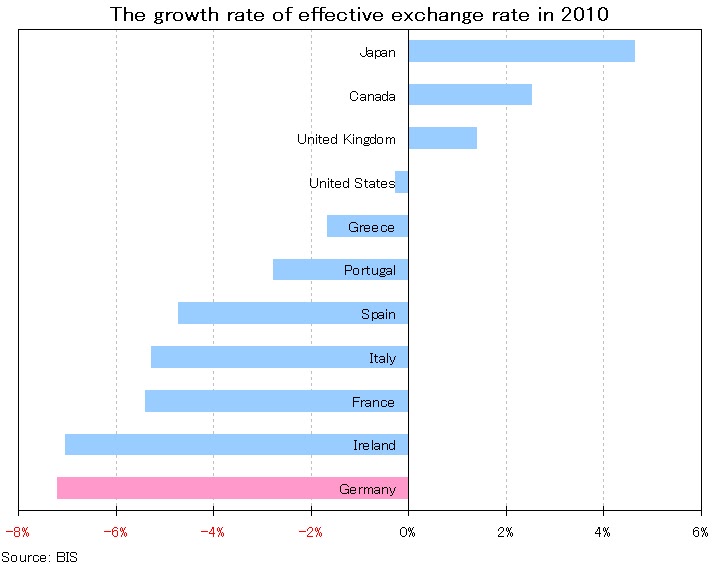
Nobody would doubt the importance of weak euro to help lift German export, as is clearly shown in the graph above. Now, you would be surprised to know how much German currency has depreciated this year.


Germany has been the biggest winner in a currency war thus far, benefiting from the effective exchange rate lower than not only G7 countries but also crisis-hit PIIGS. It's no wonder that the government raised its economic growth forecast for the largest economy in Europe.
The German government said the economy will grow this year at the fastest pace since 1991, raising its forecast as exports to China and other Asian countries boom and consumer spending revives.
Europe's largest economy will probably grow by 3.4 percent in 2010 and by 1.8 percent next year, the Economy Ministry said in a report today. The government previously forecast an expansion of 1.4 percent and 1.6 percent, respectively.
Foreign demand for cars and machines dragged Germany out recession in the second quarter of last year. Exports, which made up 41 percent of the country's gross domestic product in 2009, will grow 16 percent this year, the BGA exporters group said on Oct. 19. Sales of goods and services to countries outside Europe will grow 25 percent, the exporters said.
So far this year, according to BIS, China's currency has appreciated by 4% in real terms. Can Germany blame China on its currency policy?

Labels:

Tuesday, October 19, 2010

Germany's two-front war

ECB stopped buying government bonds last week. It's the first time since the program started in May. ECB bought 16.5 billion euros of government bonds in the first week. But since then, the amount has sharply declined, and reached nothing to zero in August. Despite the widening spreads over German Bunds, ECB's purchase has been contained for the last few months.  


ECB President Jean-Claude Trichet exchanged a spat with Bundesbank President and ECB Governor Axel Weber who advocates the early withdrawal from bond purchase program, saying "This is not the position of the Governing Council, with an overwhelming majority."

One may understand why Weber is calling for an end to the bond purchase program sooner than later if Germany's economic outlook is taken into account. IMF raised its economic forecast for Germany in 2010 to 3.3%, a staggering 1.9% point rise from a previous estimate. The reason is: weak euro.


As I showed previously, the euro has lost more than 10% of its value this year in real terms. It's due in large part to economic crisis which hit PIIGS. It's no wonder why export-dependent Germany benefits much from weak euro.

The problem is that the euro is now gaining strength because of the Fed's loose monetary policy, which could drag down Germany's feeble growth. Germany would be content if PIIGS remains weak, but their bond spreads over Germany's Bunds are narrowing since China, whose currency is widely considered to be undervalued, intends to buy Greek debt. Also, the Fed's QE2 could further strengthen the euro, thus denting the economic prospect for Germany.

The US and China. Germany would have to fight on two fronts.

Labels: